Custom Contact Fields Guide
Custom contact fields enable you to add additional details to your contacts.
Custom contact fields are either created manually or added automatically through DailyStory integrations.
To access custom contact fields, navigate to Contacts > Manage Custom Fields.
How Custom Fields are used
Custom contact fields enable you to add your own unique fields and data to your contacts. Moreover, DailyStory integrations, such as Mindbody, BigCommerce and more, automatically add custom fields to your system when installed.
Data from these fields is used for search and segmentation.
RecommendedOnly users with Administrator rights can manage custom contact fields in DailyStory.
Example Custom Fields
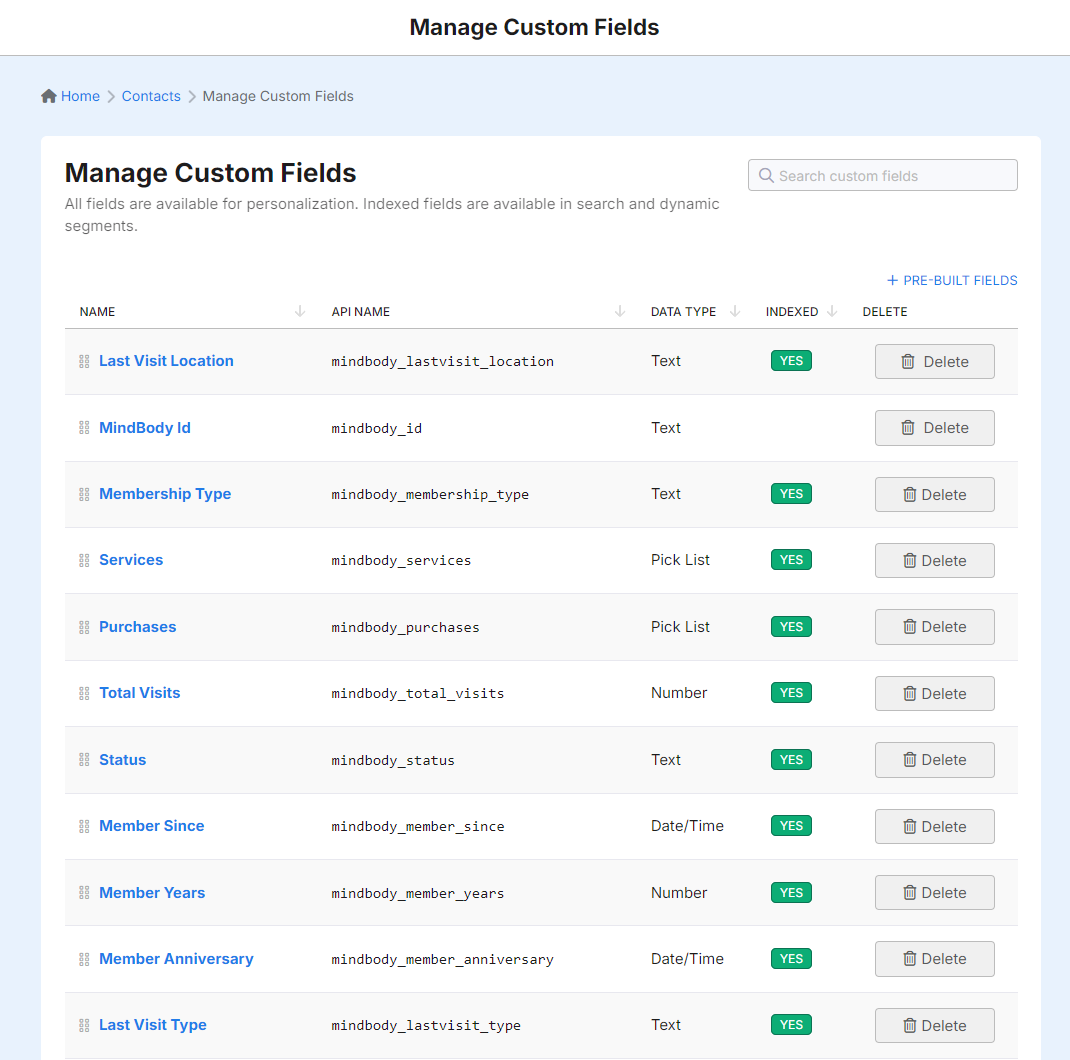
In the following example, Mindbody integration is enabled for a DailyStory account. As a result, the custom contact fields are specific Mindbody fields and are synced between Mindbody and DailyStory:
Standard fields vs object fields
The standard custom field in DailyStory is used to store a single piece of data or a list of data. Standard fields are considered "flat" in that they only represent a single piece of data. For more complex data, an object field is used. An object field can represent complex data, such as sales or appointments.
Standard field examples
An example of a flat field is Total Visits for an integration such as Mindbody or Total Sales for an integration such as Shopify. This is a single piece of information related to the contact.
A flat field can be a string, a list, a date/time, a number, a decimal, or a boolean (true/false).
For search and segmentation, a flat field could be used to: find everyone that has visited 20 times or more.
Object field examples
An example of an object field is purchase history for an integration such as Mindbody or appointments for an integration such as Forcyte. An object has multiple flat fields that describe it.
For example, purchase history:
- A contact may have zero, one or many purchases they are associated with.
- A purchase has a name, e.g. Summer Sweat.
- A purchase has a price, e.g. $100.
- A purchase has a date purchased, e.g. July 4, 2026.
For search and segmentation, an object field could be used to: find everyone that purchased Summer Sweat June 1, 2025 through July 15, 2025 and paid at least $100.